Pots
A pot is the heart of kapiche: a prediction question with two sides, like Yes or No, that people call and then watch resolve.
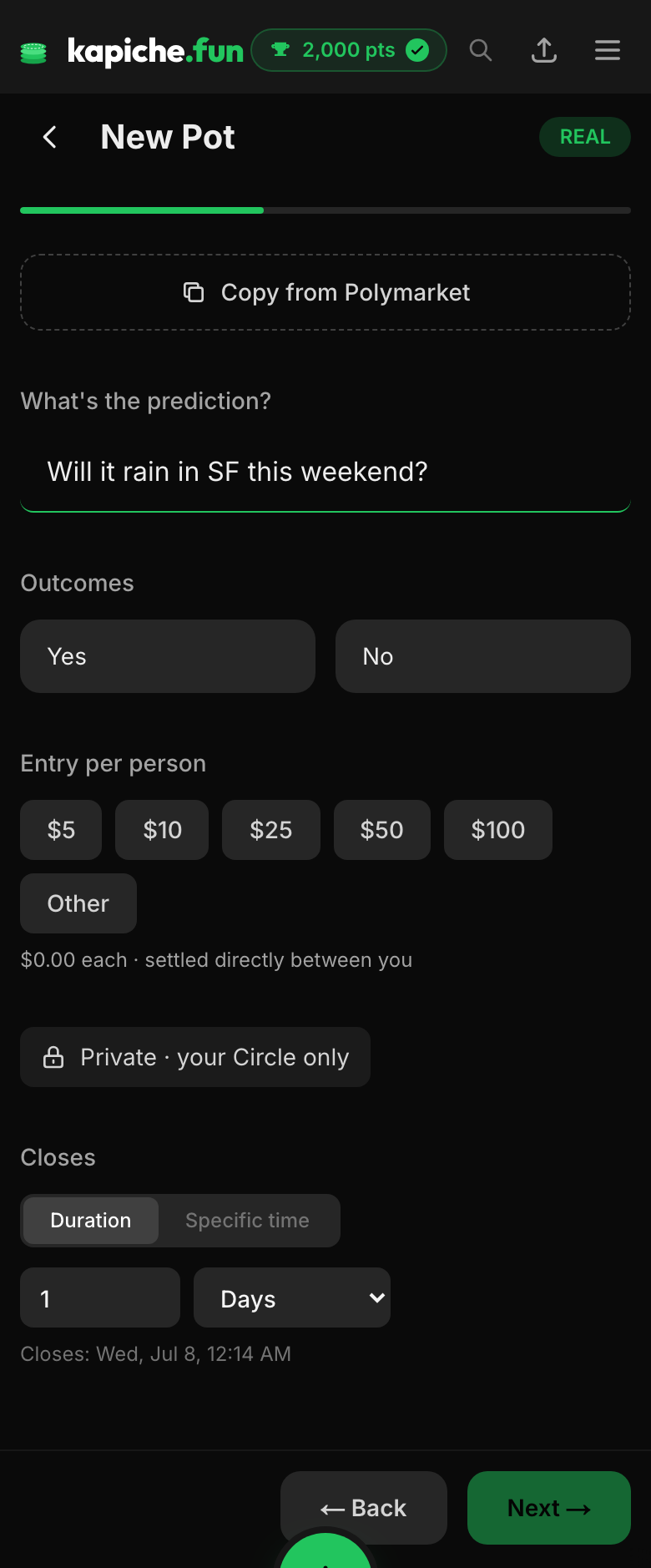
Every prediction on kapiche is a pot. Someone asks a question with a clear answer in the future ("Will it rain in SF this weekend?", "Will BTC close above $80k Friday?"), lays out the sides, and sets a close time. You make a call by picking a side. When the pot resolves, everyone who called it right is on the record.
Two kinds of pot
Pots come in two flavors, depending on what you are putting behind your call.
Public points pots
Play-money pots that anyone can find in the Discover feed. You call them with free points for fun and to build your track record. Points are never shown with a dollar sign and can never be cashed out.
Private real-money pots
Pots you run with people you know, using your own USDC on Solana. These are private and live inside a Circle or an invited group, never the public feed. 18+.
Points are not money
How a pot is created
Tap create and the wizard walks you through it. Real-money pots carry a sky-blue REAL badge and a few extra requirements; points pots are quicker and public by default.
Write the question
Set the two sides
Choose the entry or stake
Pick a referee
Set the close time and share
How a pot resolves
When the close time passes, the result gets settled one of two ways:
Auto-resolves
Many public pots mirror Polymarket and resolve automatically from the source. The dollar volume shown on those pots is Polymarket's real volume, clearly attributed, not the kapiche pot.
Called by a referee
For pots without a source, the chosen referee calls the outcome. Once they do, the result is final and every call updates the players' reputation.
How winnings are paid
What a winning call pays depends on the kind of pot. There are two payout models:
Community pots: split the pot
Every stake goes into one shared pot. When it resolves, the whole pot is split among the winners in proportion to what each one put in. With a fixed entry that means an even split: 10 players in for 100 pts each and 4 winners pays each winner 250 pts.
Polymarket-mirrored pots: locked odds
The market probability at the moment you commit is locked to your call. A winning call pays your stake times 100 divided by that percentage: call a 25% side right and you get 4x your stake back, while a 99% favorite pays about 1.01x.
Either way, a payout includes your own stake back, and it is always in the pot's own currency. Points pots pay points, shown as pts and never as dollars. Private real-money pots settle peer to peer in USDC, straight between the players themselves.
Next: make a call